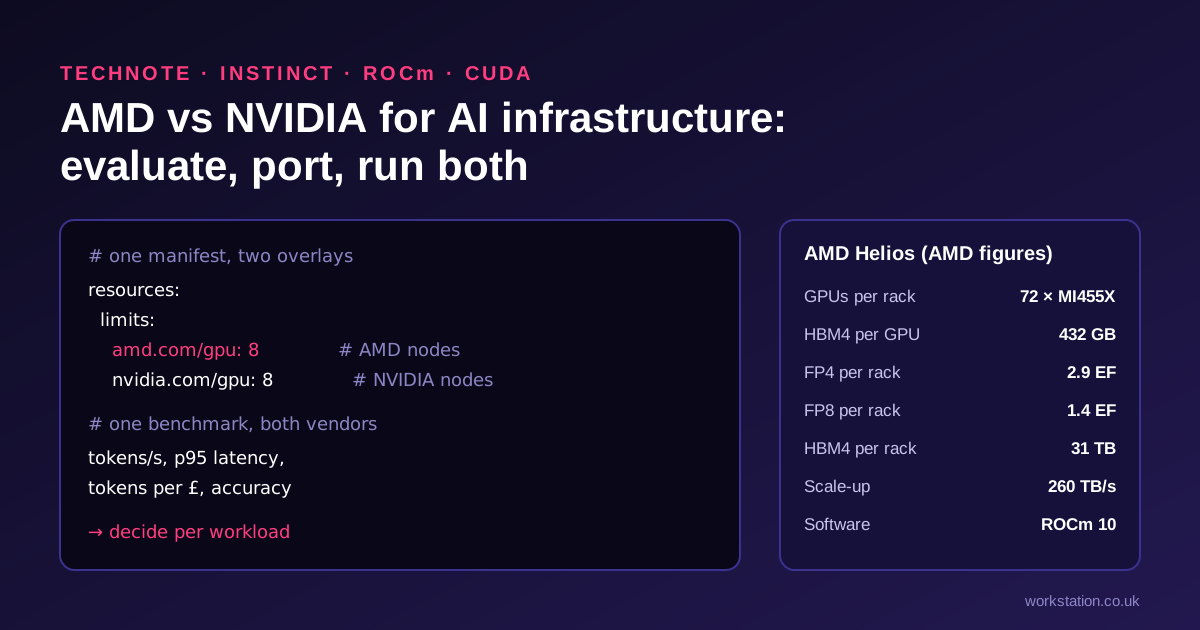
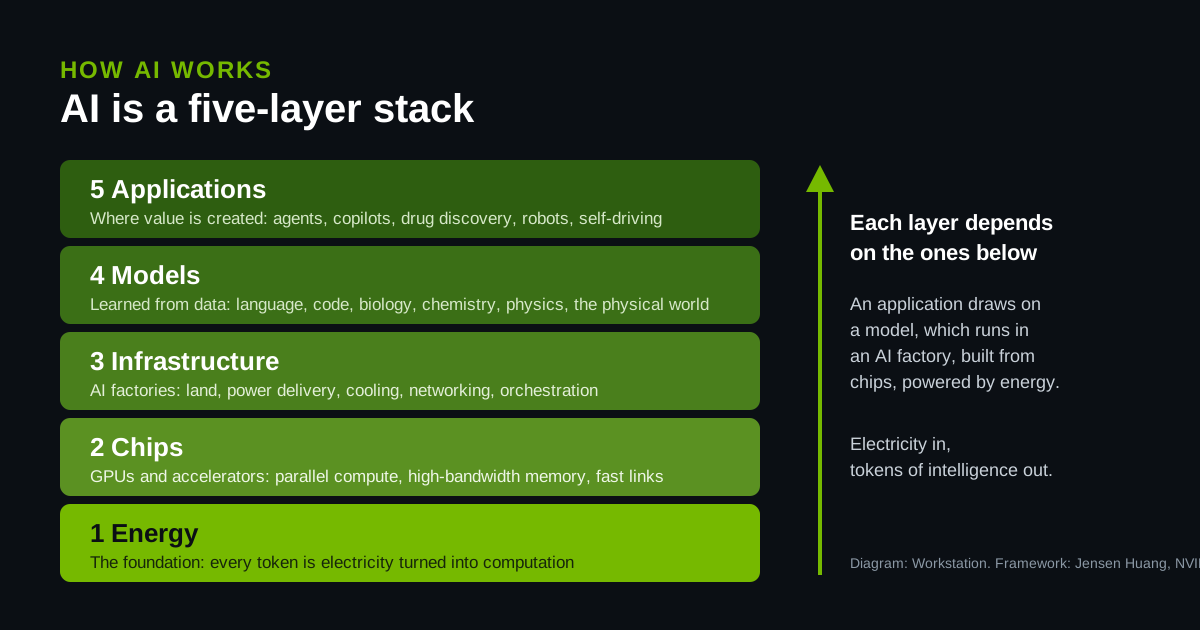
"AI" is used for everything from a chatbot to a robot to a power station deal, which makes it hard to explain. Jensen Huang, NVIDIA's founder, gave one of the clearest pictures of it: AI is a five-layer cake of energy, chips, infrastructure, models and applications. He used it at the World Economic Forum in Davos in January 2026 and set it out in an NVIDIA blog post, "AI Is a 5-Layer Cake", in March. This note explains what AI is, how it works from the power station to the app on your screen, and why each layer matters to anyone buying or building AI. The framework and the points we attribute to him are his; the explanations and the practical advice are ours.
Contents
- What AI is: from retrieving answers to generating them
- Layer 1: Energy
- Layer 2: Chips
- Layer 3: Infrastructure, the AI factory
- Layer 4: Models
- Layer 5: Applications
- Why the layers matter together
- What it means for jobs
- What it means for your business
1. What AI is: from retrieving answers to generating them
For most of computing history, software was written in advance. A person worked out the steps, the computer followed them, and data was stored in neat tables to be looked up with precise queries. Ask for a file and the computer fetched the file that was already there.
AI works differently. A model learns patterns from huge amounts of examples: text, code, images, sound, and increasingly proteins, molecules and sensor readings from the physical world. When you ask it something, it doesn't fetch a stored answer. It generates a new one, piece by piece, from what it has learned and the context you gave it. Those pieces are called tokens: fragments of words, pixels, sounds, or any other kind of data.
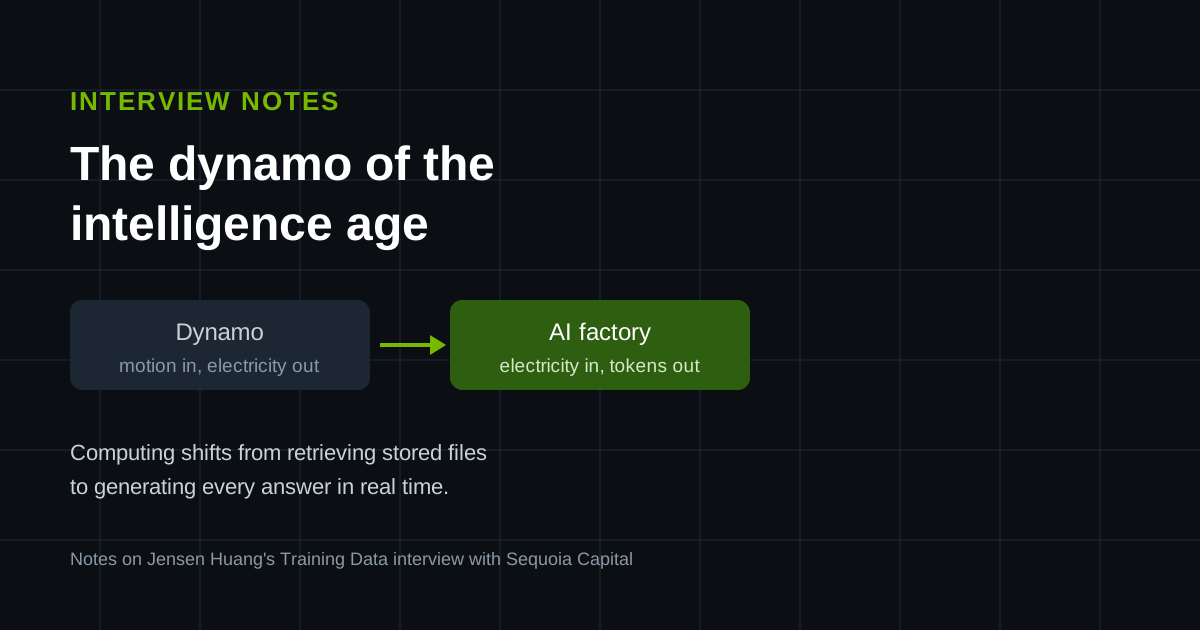
That is Huang's starting point. Because every answer is created fresh, at the moment it's needed, AI needs computing power and electricity at the moment it's used, not just a place to keep files. That's why he describes AI not as an app or a single model, but as essential infrastructure, like electricity and the internet, built in five layers.
| Traditional computing | AI | |
|---|---|---|
| What the computer does | Follows steps a person wrote | Uses patterns it learned from data |
| Data it understands | Structured tables and fields | Text, images, sound, video, code, scientific data |
| How it answers | Retrieves something already stored | Generates a new answer for your context |
| Where it runs | Data centres built to store and serve files | AI factories built to produce tokens |
2. Layer 1: Energy
Everything starts with electricity. Every token an AI produces is the result of electricity being turned into computation, and heat being taken away. Huang calls energy the first principle of AI infrastructure and the binding constraint: it sets the ceiling on how much intelligence can be produced at all.
Why it matters: in the UK, the hardest part of a new AI data centre is often not the GPUs but the grid connection, which can take years. For smaller deployments the question is local: can your building or server room supply and cool a rack that draws many times more power than an ordinary IT rack? Energy costs also flow straight into the price of every answer an AI gives.
3. Layer 2: Chips
Above energy are the chips that turn electricity into computation. AI needs a particular kind: processors that do thousands of calculations at once (parallelism), memory fast enough to keep them fed (high-bandwidth memory), and links fast enough to make many chips act as one. GPUs fit this, which is why they became the engine of modern AI.
Why it matters: progress at this layer decides how fast AI can grow and how cheap each answer becomes. Each GPU generation produces more tokens for the same power. Choosing hardware is a balance of memory (which decides how large a model you can run), speed, power draw and availability. A 128 GB desktop system such as DGX Spark, a 96 GB RTX PRO 6000 server, and a rack of the latest data-centre GPUs each suit very different jobs.
4. Layer 3: Infrastructure, the AI factory
Chips on their own don't make AI. They need land, buildings, power delivery, cooling, networking, and the software that makes tens of thousands of processors work as one machine. Huang calls these facilities AI factories: they aren't built to store information, but to manufacture intelligence.
Why it matters: this is where most projects succeed or fail in practice. The questions are physical and operational: rack power and liquid cooling, the network between servers, storage fast enough for training data, scheduling, monitoring, security, and who runs it all. You can own this layer, lease it, or rent it from a cloud. The right answer depends on how busy the hardware will be and where your data must stay.
5. Layer 4: Models
Above the infrastructure are the models, the part most people think of as "AI". Huang stresses that language models are only one category. Models now understand biology, chemistry, physics, finance, medicine and the physical world, and some of the most important work is in protein design, chemistry, simulation, robotics and self-driving systems.
A model goes through two stages. Training is when it learns from data; it needs the most compute and happens occasionally. Inference is when it's used to answer questions or do work; it happens every time someone uses it and, at scale, uses more compute in total. Huang also points to open models, which are free to download and run: when an open model reaches the frontier, as DeepSeek-R1 did, it lifts demand across every layer beneath it.
Why it matters: the model you choose decides your costs, your hardware and your data risk. A large frontier model through an API is quick to start with. An open model running on your own hardware keeps data in-house and can cost less at high volume. Most organisations end up using both.
6. Layer 5: Applications
At the top are applications, where the economic value is created: drug discovery platforms, industrial robots, legal copilots, customer service agents, coding assistants, self-driving cars. In Huang's words, a self-driving car is an AI application embodied in a machine, and a humanoid robot is an AI application embodied in a body: same stack, different outcomes.
The big change, he says, came in the past year: models became good enough to be useful at scale. Reasoning improved, mistakes and "hallucinations" dropped, and answers became better grounded in real sources. AI moved from answering questions to doing work, as agents that plan steps and use tools.
Why it matters: this is the only layer your customers see, and the one that has to pay for everything underneath. Start from a business problem that's worth solving, then work down the stack to what it needs.
7. Why the layers matter together
The point of the cake is that no layer stands alone. Every successful application pulls on every layer beneath it, "all the way down to the power plant that keeps it alive", as Huang puts it. Better chips make answers cheaper; cheaper answers make more applications worthwhile; more applications need more infrastructure and more energy. Every layer reinforces the others.
That's why Huang calls this the largest infrastructure buildout in human history, and why he argues it is still early: a few hundred billion dollars in, with trillions of dollars of infrastructure still to build. It's also why AI touches so many industries at once, from power generation and construction to software and healthcare.
8. What it means for jobs
Huang makes two points about work. First, the buildout itself needs huge numbers of skilled people: electricians, plumbers, pipefitters, steelworkers, network technicians, installers and operators. You don't need a computer science PhD to take part.
Second, AI takes on tasks rather than whole jobs. His example is radiology: AI now helps read scans, yet demand for radiologists keeps growing, because a radiologist's purpose is caring for patients, not reading scans. When AI handles routine work, hospitals serve more patients and hire more people. In his words, productivity creates capacity, and capacity creates growth.
9. What it means for your business
You don't need to own all five layers. But you need to know which ones you depend on, and make a deliberate choice at each:
| Layer | The question to ask | How Workstation helps |
|---|---|---|
| Applications | Which business problem is worth solving first, and how will we measure it? | AI agents, AI consultancy, agent building |
| Models | Frontier API, open model, or both? Where must the data stay? | Private AI, MLOps set-up |
| Infrastructure | Own, lease or rent? Who runs it? | GPU clusters, GPU leasing, AI data centre |
| Chips | How much GPU memory and speed does the workload need? | AI workstations, DGX Spark and RTX PRO servers in our shop |
| Energy | Can our site power and cool it? What will each answer cost to run? | Power and cooling planning as part of every server and cluster project |
Talk to us about where your organisation sits on the cake, and what to build or buy next.
Sources
- Jensen Huang, "AI Is a 5-Layer Cake", NVIDIA Blog, 10 March 2026.
- NVIDIA Blog, "Largest Infrastructure Buildout in Human History": Jensen Huang on AI's "Five-Layer Cake" at Davos, January 2026.
Jensen Huang resigned as NVIDIA's President and CEO on 12 November 2026; the views quoted here were given while he led the company. NVIDIA and DGX are trademarks and/or registered trademarks of NVIDIA Corporation in the U.S. and other countries.