商店現已上線

我們打造用於網站、AI 智慧體和 LLM 訓練的 Workstation AI 機器——線上配置併購買。

獲取同行價格
AI 產品
AI 實驗室OpenAI 智慧體Claude 代理Grok BotWorkstation AI 原生 CRM營銷所有產品
AI 解決方案
應用型 AIAI 智慧體生成式 AIAI 自動化AI 技能提升中小企業 AI 套餐企業 AI 實驗室AI 工作站NVIDIA 硬體與軟體NVIDIA 加速計算私有 AIGPU 私有云GPU 叢集邊緣 AI行業 AI
AI 服務
平臺現代化數字工程資料基礎與 AI自主運營AI 諮詢DevOps 自動化網路安全軟體開發智慧體構建MLOps 搭建GPU 租賃GPU 私有云
關於我們
公司我們的故事合作伙伴客戶案例
AI 資料中心
AI 資料中心GPU 私有云GPU 叢集GPU 租賃
AI 洞察Jev 系列基準測試實驗室模型選擇
技術說明
文件
Linux 作業系統UbuntuRed Hat Enterprise LinuxSUSE LinuxAlpine LinuxDebian、Rocky 與 AlmaLinux
AI 雲平臺AWS 與 Amazon BedrockGoogle Cloud 與 Vertex AIMicrosoft Azure 與 AI FoundryGPU 雲與算力市場
私有 AI 資料中心面向律師事務所面向會計師事務所本地部署平臺全面安全的雲
工具Ring PromoterJobshout
新聞
部落格
聯絡我們登入

面向現代企業的 AI 工作站、AI 多智慧體軟體、GPU 基礎設施和智慧代理解決方案。

聯絡我們

AI 解決方案

應用型 AIAI 智慧體生成式 AIAI 自動化AI 技能提升中小企業 AI 套餐企業 AI 實驗室行業 AI

產品

所有產品Workstation AI native CRM 與 ERP營銷OpenAI 智慧體Ring PromoterJobshout

公司

關於我們公司AI 資料中心為什麼選擇Workstation合作伙伴客戶案例定價聯絡TenthMatrix

資源

AI 洞察技術說明文件Linux 作業系統AI 雲平臺私有 AI 資料中心部落格搜尋網站地圖
英國總部
77-79 Marlowes, Hemel Hempstead HP1 1LF路線指引 — 從 M25 外環倫敦 20 號出口駛出公司編號: 11641870週一至週五:上午 9:00 - 下午 6:00 GMT
+44 7515 356 146
比利時辦公室
Workstation SRL, Rue Vanderkindere 34, 1180 Uccle, BrusselsBE 0751.518.683週一至週五:上午 9:00 - 下午 6:00 CET
+32 492 45 67 46
印度辦公室
#159 Sector 9, Pocket 1, DDA Flats, 110077 Dwarka, New Delhi
+91 98881 98841
台灣辦公室
3F, No. 2-4, Aisi Rd., Ren'ai Dist., Keelung City 200, Taiwan基隆市仁愛區愛四路2之4號3樓週一至週五:上午 9:00 - 下午 6:00 臺灣時間(GMT+8)
+886 926 892 701+32 492 45 67 46

© 2026 Workstation AI。保留所有權利。

隱私資料刪除Cookie服務條款網站地圖

NVIDIA、NVIDIA 標誌、RTX、RTX PRO、Blackwell、CUDA、NVLink、MGX、Omniverse、Spectrum-X、Quantum、BlueField、DGX 與 HGX 為 NVIDIA Corporation 在美國及其他國家的商標及/或註冊商標。AMD、AMD Arrow 標誌、EPYC、Instinct、Ryzen 與 Threadripper 為 Advanced Micro Devices, Inc. 的商標。Dell 與 PowerEdge 為 Dell Inc. 或其子公司的商標。Intel 與 Xeon 為 Intel Corporation 或其子公司的商標。AMAX、AceleMax 與 LiquidMax 為 AMAX Engineering Corporation 的商標。所有其他產品名稱、標誌與品牌均為其各自所有者之財產。我們使用它們僅為識別我們所描述、供應或支援的產品;使用這些名稱並不表示其所有者為我們背書。

Loading blog...

首頁 / 部落格
AIAmdData CentreGPUNvidia

Chipping Away at Nvidia's Lead: Lisa Su's AMD Plan, Two Years On
Workstation2026年11月14日4 min read
79f02641 8b11 4fbd babc e97a18613314

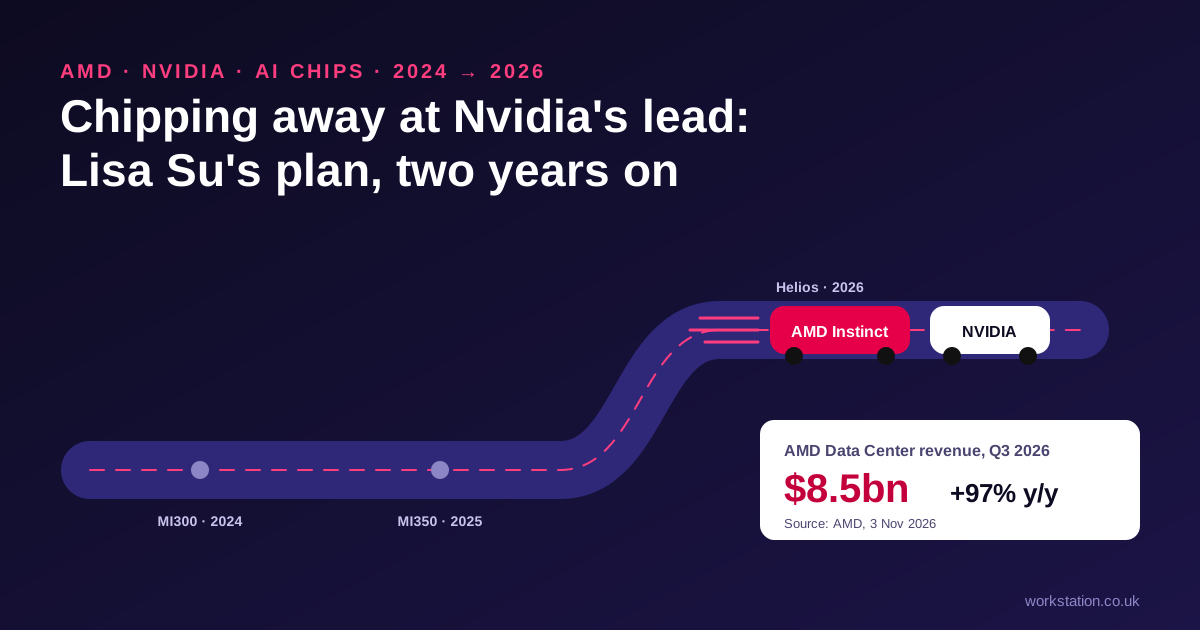
In December 2024, Bloomberg's Emily Chang visited AMD's labs in Austin to ask Lisa Su, ten years into her time as CEO, how she planned to chip away at Nvidia's lead in AI. Almost two years on, AMD's own results let us check the plan against what happened, and ask what it means for UK organisations buying AI infrastructure today.

Watch the interview. AMD's CEO Wants to Chip Away at Nvidia's Lead | The Circuit with Emily Chang (Bloomberg Originals, 24 minutes, published 6 December 2024).

What Lisa Su said

The episode is part company profile, part race story, and Su's lines are worth hearing in full. The points that matter for anyone buying AI hardware:

  • The pace. She called AI "the most transformational technology that I've seen in my career", ahead of the internet, PCs, mobile and cloud, and said the industry had made more progress in the previous 18 months than in the ten years before.
  • The product. She showed the Instinct MI300, already in production and running work such as GPT-4o on Microsoft Azure and Meta's Llama models.
  • The underdog question. Asked whether being seen as the next-best option to Nvidia was good enough, she said AMD has always "punched well above our weight" in technology. Bloomberg's chip reporter Ian King described AMD as "a solid number two".
  • Custom chips. On hyperscalers designing their own silicon: "This is a huge market... There's like more than enough chips for everybody to build."
  • Export controls and supply. She accepted there is "a national security element" to limits on AI chip exports, while wanting "as open a market as possible", and stressed resilience in a supply chain concentrated in Taiwan.

The rest covers her ten years turning AMD around (the Zen architecture was "the most important moment"), the Mercedes Formula 1 partnership, a Porsche collection named after AMD products, and her advice to young engineers: "run towards problems".

Two years on: the scorecard
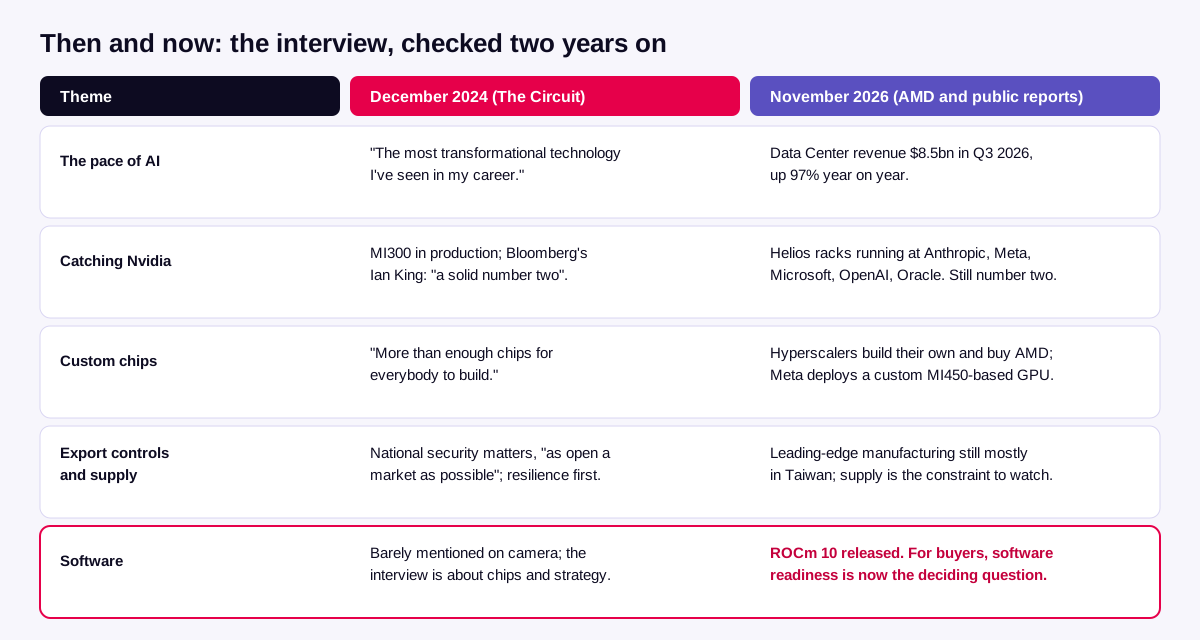
What Lisa Su said in December 2024, and what has happened since. Five themes from the interview checked against November 2026. AI pace: she called AI the most transformational technology of her career; AMD's Data Center revenue has nearly doubled year on year. Competing with Nvidia: Bloomberg called AMD a solid number two; Helios now ships to five of the largest AI buyers, though Nvidia remains far larger. Custom chips: she said there are more than enough chips for everybody; hyperscalers build their own and also buy AMD, and Meta is deploying a custom MI450-based GPU. Supply resilience and export controls: she backed national-security controls with as open a market as possible, and stressed supply-chain resilience; manufacturing is still concentrated in Taiwan. Software: not covered in depth on camera; ROCm 10 is now the deciding factor for most buyers.
Five themes from the December 2024 interview checked against November 2026. Sources: the Bloomberg Originals episode and AMD's third-quarter 2026 results.

AMD's third-quarter 2026 results, published on 3 November, are the clearest check. Data Center revenue reached a record $8.5bn, up 97% year on year, driven by EPYC server processors and the launch of the Instinct MI450 Series. Anthropic, Meta, Microsoft, OpenAI and Oracle Cloud Infrastructure are running models on the first Helios racks, AMD's answer to Nvidia's rack-scale systems. AMD expects around $17bn of total revenue in the fourth quarter.
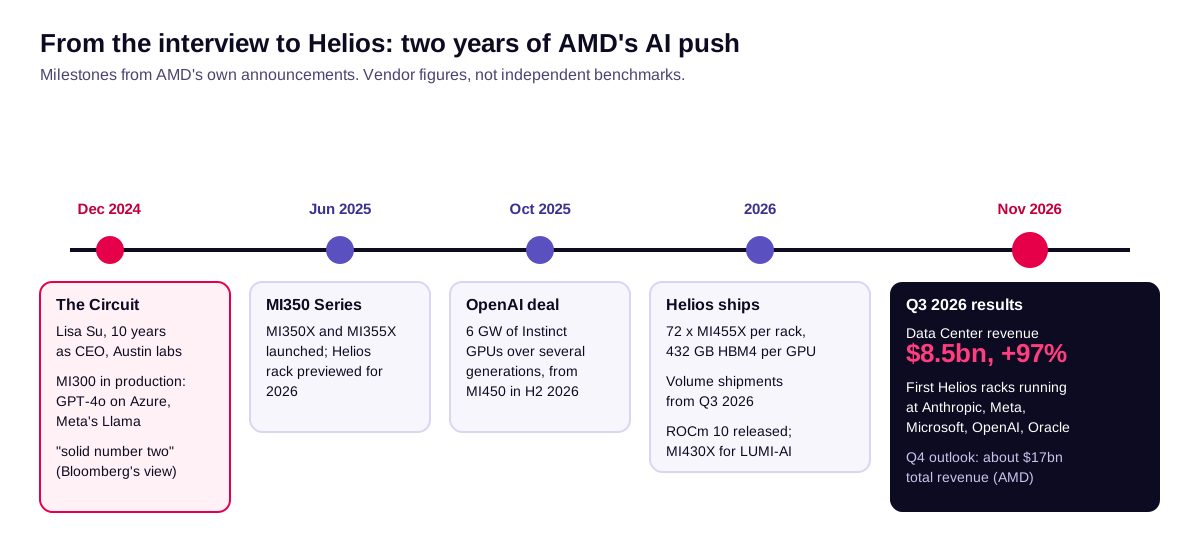
AMD's AI data-centre push, December 2024 to November 2026. A timeline. December 2024: Lisa Su on Bloomberg's The Circuit, ten years as CEO, with the Instinct MI300 in production and running GPT-4o on Microsoft Azure and Meta's Llama. June 2025: Instinct MI350 Series launched. October 2025: multi-year agreement with OpenAI for 6 gigawatts of Instinct GPUs. 2026: Helios rack-scale system with 72 Instinct MI455X GPUs enters production and ships in volume in the third quarter; ROCm 10 released. November 2026: third-quarter Data Center revenue a record 8.5 billion dollars, up 97 percent year on year, with Anthropic, Meta, Microsoft, OpenAI and Oracle running workloads on the first Helios racks.
From the interview to Helios: MI350 in June 2025, the OpenAI agreement in October 2025, Helios shipping in volume from the third quarter of 2026. Milestones from AMD's announcements.

Helios packs 72 Instinct MI455X GPUs into one rack, each with 432 GB of the newest HBM4 memory, for 31 TB per rack. AMD claims it beats Nvidia's Vera Rubin NVL72 on compute, memory and tokens per dollar. Those are AMD's numbers, and Nvidia remains far larger, with the deeper software ecosystem. But "solid number two" now means a second full platform that the biggest AI companies run in production, not a niche alternative.

What it means if you are buying AI infrastructure in the UK

  1. You have a real choice. For many workloads, especially serving large language models with long contexts, AMD's larger memory per GPU can mean fewer GPUs per model. That is worth testing, not assuming.
  2. Software is the deciding question. Code written in PyTorch, or served with vLLM or SGLang, usually runs on AMD's ROCm software with little change. Custom CUDA code and Nvidia-only tools are where the work is.
  3. Two vendors give you leverage. Teams that can run on both negotiate better prices and are less exposed when one vendor's lead times stretch.
  4. Supply risk has not gone away. As Su said, the industry depends on a concentrated supply chain. Plan lead times into AI projects whichever vendor you choose.
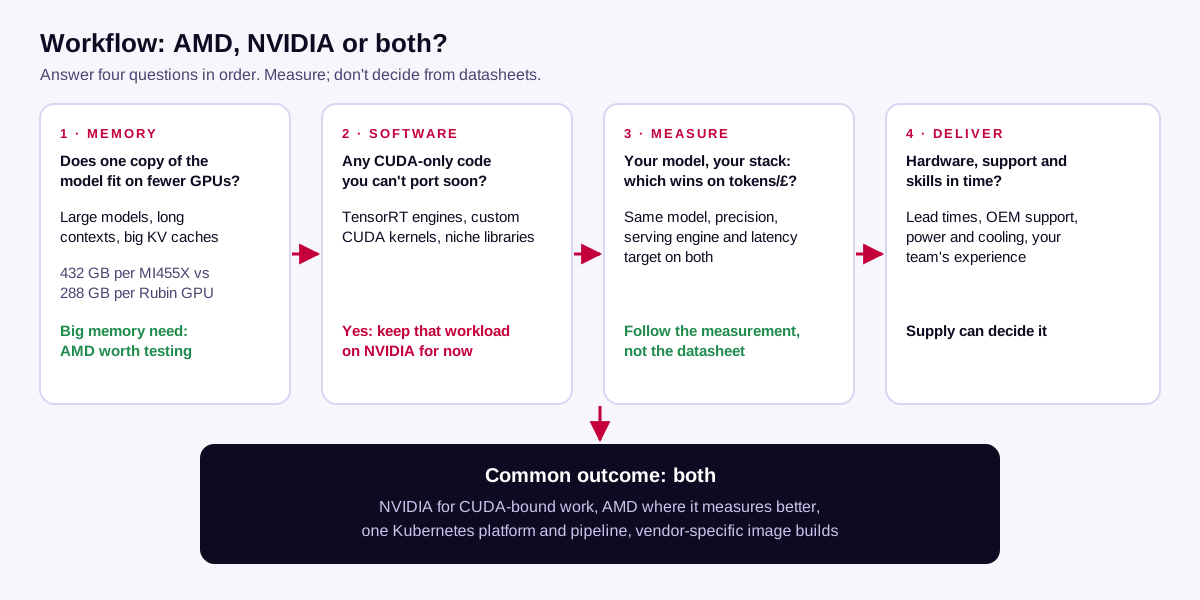
Workflow: choosing AMD, NVIDIA or both for an AI project. Four questions in sequence. Does the model need more memory per GPU than you can comfortably get, for example very large models or long contexts? If so, AMD's 432 GB per GPU can reduce how many GPUs each copy of the model needs. Does your software depend on CUDA-only libraries or custom kernels you cannot port soon? If so, stay on NVIDIA for that workload. Does a benchmark of your own model, on your own serving stack, show better tokens per pound on one vendor? Follow the measurement, not the datasheet. Can you get the hardware, support and skills in time? Supply, lead times and your team's experience can decide it. Many organisations end with both: NVIDIA for CUDA-bound work and AMD where it measures better.
Four questions to decide between AMD, Nvidia or both: memory, software dependencies, a benchmark on your own model, and whether hardware and skills arrive in time.

For the full engineering detail, with the platforms compared layer by layer, memory arithmetic, the CUDA-to-ROCm software map, a porting workflow with commands, running both vendors on one Kubernetes platform and a fair benchmarking method, read our technote: AMD Instinct vs NVIDIA for AI infrastructure: evaluate, port and run both.

How Workstation helps

We design and run GPU infrastructure for UK organisations and help teams evaluate AMD alongside Nvidia: a like-for-like benchmark of your own model on both, a check of your code for CUDA-only dependencies, and a Kubernetes platform that runs either. See our GPU private cloud guide, which includes AMD's official Helios video, compare leasing and buying at gpuleasing.co.uk, or talk to us.

Quotes are from the Bloomberg Originals video. Company figures are from AMD's announcements and are vendor claims, not independent benchmarks. This post is independent and not endorsed by Bloomberg, AMD or Nvidia.

Acknowledgement of rights: AMD, Instinct, EPYC, ROCm, Helios and Zen are trademarks of Advanced Micro Devices, Inc. NVIDIA and Vera Rubin are trademarks of NVIDIA Corporation. Bloomberg is a trademark of Bloomberg Finance L.P. Other names are the property of their respective owners.