商店现已上线

我们打造用于网站、AI 智能体和 LLM 训练的 Workstation AI 机器——在线配置并购买。

获取同行价格
AI 产品
AI 实验室OpenAI 智能体Claude 代理Grok BotWorkstation AI 原生 CRM营销所有产品
AI 解决方案
应用型 AIAI 智能体生成式 AIAI 自动化AI 技能提升中小企业 AI 套餐企业 AI 实验室AI 工作站NVIDIA 硬件与软件NVIDIA 加速计算私有 AIGPU 私有云GPU 集群边缘 AI行业 AI
AI 服务
平台现代化数字工程数据基础与 AI自主运营AI 咨询DevOps 自动化网络安全软件开发智能体构建MLOps 搭建GPU 租赁GPU 私有云
关于我们
公司我们的故事合作伙伴客户案例
AI 数据中心
AI 数据中心GPU 私有云GPU 集群GPU 租赁
AI 洞察Jev 系列基准测试实验室模型选择
技术说明
文档
Linux 操作系统UbuntuRed Hat Enterprise LinuxSUSE LinuxAlpine LinuxDebian, Rocky & AlmaLinux
AI 云平台AWS & Amazon BedrockGoogle Cloud & Vertex AIMicrosoft Azure & AI FoundryGPU 云与算力市场
私有 AI 数据中心面向律师事务所面向会计师事务所本地部署平台全面安全的云
工具Ring PromoterJobshout
新闻
博客
联系我们登录

面向现代企业的 AI 工作站、AI 多智能体软件、GPU 基础设施和智能代理解决方案。

联系我们

AI 解决方案

应用型 AIAI 智能体生成式 AIAI 自动化AI 技能提升中小企业 AI 套餐企业 AI 实验室行业 AI

产品

所有产品Workstation AI native CRM 与 ERP营销OpenAI 智能体Ring PromoterJobshout

公司

关于我们公司AI 数据中心为什么选择Workstation合作伙伴客户案例定价联系TenthMatrix

资源

AI 洞察技术说明文档Linux 操作系统AI 云平台私有 AI 数据中心博客搜索网站地图
英国总部
77-79 Marlowes, Hemel Hempstead HP1 1LF路线指引 — 从 M25 外环伦敦 20 号出口驶出公司编号: 11641870周一至周五:上午 9:00 - 下午 6:00 GMT
+44 7515 356 146
比利时办公室
Workstation SRL, Rue Vanderkindere 34, 1180 Uccle, BrusselsBE 0751.518.683周一至周五:上午 9:00 - 下午 6:00 CET
+32 492 45 67 46
印度办公室
#159 Sector 9, Pocket 1, DDA Flats, 110077 Dwarka, New Delhi
+91 98881 98841
台湾办公室
3F, No. 2-4, Aisi Rd., Ren'ai Dist., Keelung City 200, Taiwan基隆市仁愛區愛四路2之4號3樓周一至周五:上午 9:00 - 下午 6:00 台湾时间(GMT+8)
+886 926 892 701+32 492 45 67 46

© 2026 Workstation AI。保留所有权利。

隐私数据删除Cookie服务条款网站地图

NVIDIA, the NVIDIA logo, RTX, RTX PRO, Blackwell, CUDA, NVLink, MGX, Omniverse, Spectrum-X, Quantum, BlueField, DGX and HGX are trademarks and/or registered trademarks of NVIDIA Corporation in the US and other countries. AMD, the AMD Arrow logo, EPYC, Instinct, Ryzen and Threadripper are trademarks of Advanced Micro Devices, Inc. Dell and PowerEdge are trademarks of Dell Inc. or its subsidiaries. Intel and Xeon are trademarks of Intel Corporation or its subsidiaries. AMAX, AceleMax and LiquidMax are trademarks of AMAX Engineering Corporation. All other product names, logos and brands are the property of their respective owners. We use them only to identify the products we describe, supply or support; their use does not mean their owners endorse us.

首页 / 技术说明 / Technology
DevOpsSecurityAISRE

WSLVault: Why AI Agents Need Cryptographic Secrets Isolation

Technical brief: why agentic systems raise the stakes for secret lifecycle, cosmetic tenant filters vs cryptographic refusal, envelope keys, leases, and video chapters

2026年9月24日Technology4 min read

Long-form companion to the blog. For platform and security architects shipping AI agents on shared infrastructure: why secret lifecycle is non-negotiable, and why isolation must be cryptographic — not a WHERE clause. Product: Workstation WSL Vault · wslvault.org · GitHub.
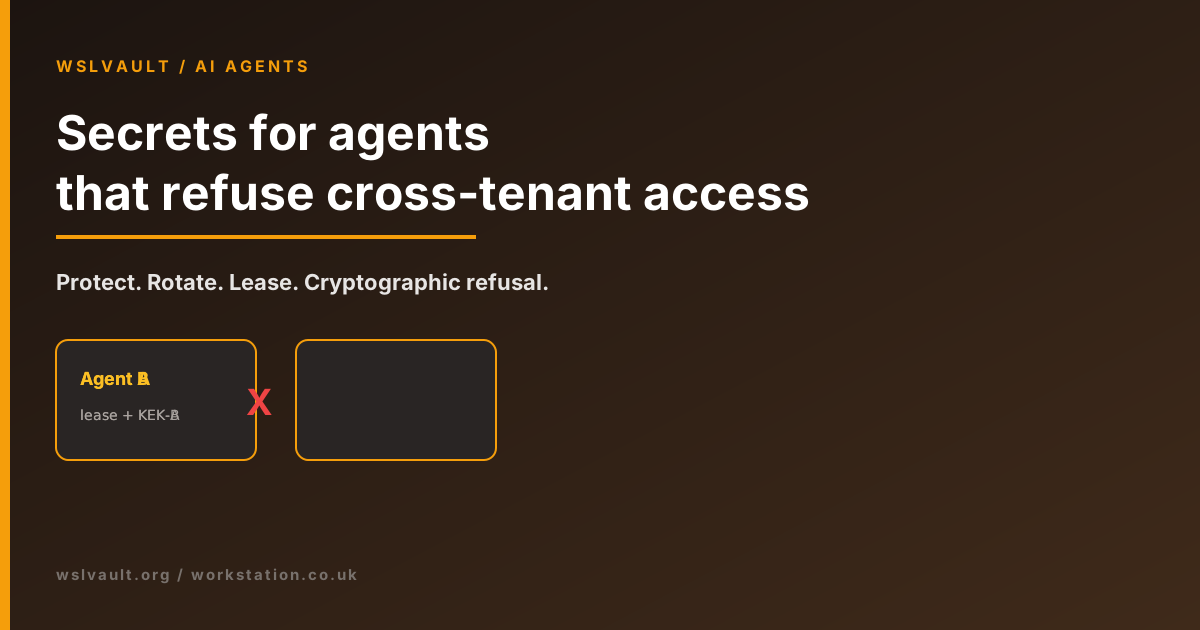
WSLVault — AI agents and cryptographic secrets isolation

~20 min — youtu.be/O6q3_H0k2M8 · same recording angled for tenancy

Thesis. AI agents amplify every secrets mistake: they call tools at machine speed, keep credentials across loops, and often share multi-tenant platforms. Protecting, rotating, and managing secrets is therefore more critical for agents than for classic services — and isolation that depends only on application filters is not isolation.

1. Why protecting, rotating, and managing secrets is even more critical for AI agents

Classic apps usually fetch a small set of credentials at startup. Agents are different:

  • Tool sprawl — one session may need cloud APIs, databases, ticketing, email, and MCP servers. Each credential is a live capability, not a config value.
  • Session persistence — keys sitting in env files, chat context, or MCP configs outlive a single request. Without rotation and leases, compromise windows stay open.
  • Autonomous action — once an agent holds a token, it will use it. There is no “wait for the human to notice” between leak and abuse.
  • Multi-tenant agent platforms — Team A’s agent and Team B’s agent may share schedulers, storage, and observability. A bug or a stolen database dump must never hand one tenant the other’s plaintext.
  • Compliance and audit — regulators and customers ask who accessed which secret, for which agent, and whether the trail can be tampered with.

That is why the control set for agents is stricter: protect (envelope encryption at rest), rotate (KEK/DEK and static roles on a period), and manage (identity-bound policies, short-lived leases, real revoke).

Agent digest. (1) Never put long-lived secrets in agent prompts or MCP config files. (2) Issue dynamic credentials with TTL; renew near expiry; revoke on stop. (3) Bind identity per tenant and per agent workload. (4) Assume shared infrastructure — require cryptographic tenant isolation, not cosmetic tenant IDs.

2. Why tenant IDs alone are cosmetic isolation

Most “multi-tenant vaults” isolate with application filters: WHERE tenant_id = ?. That fails closed only if every code path is perfect forever — including backups, analytics jobs, support tools, and the next junior PR.

When Team A and Team B share a platform, ask: can a bug or a stolen database dump ever hand one team the other’s plaintext? If the answer depends on a filter, the answer is yes.
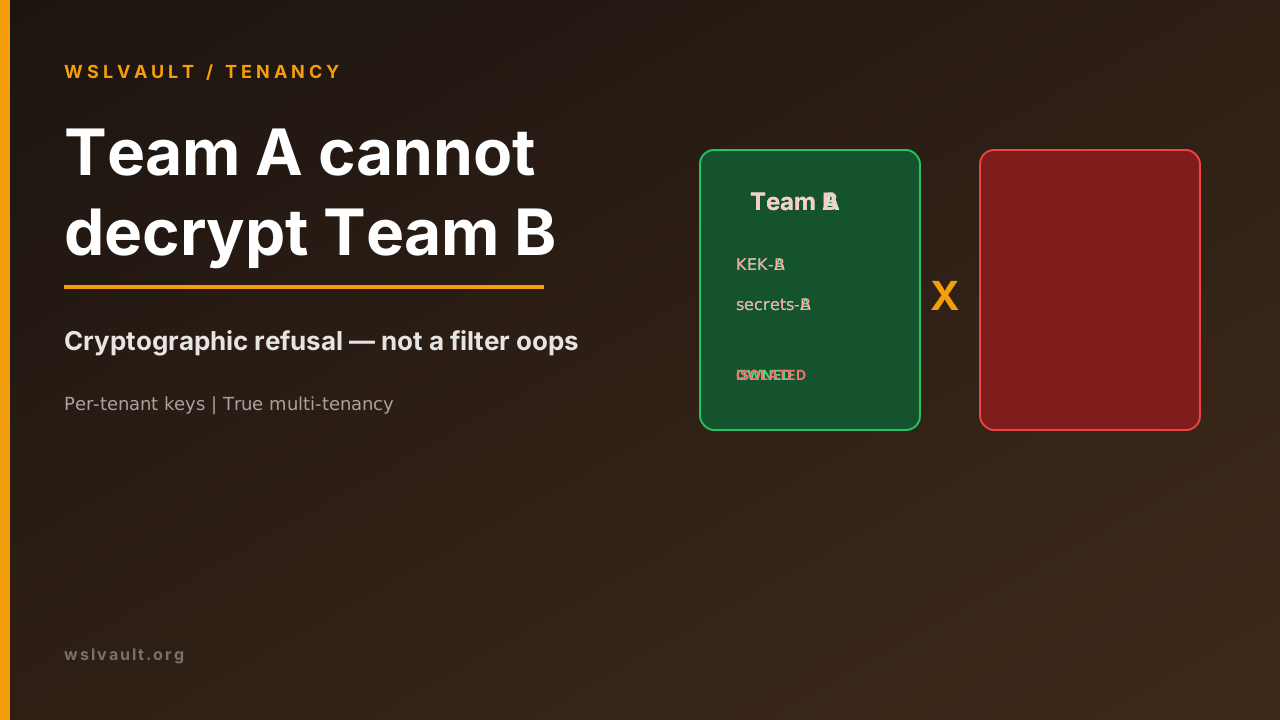
Team A cannot decrypt Team B

3. Cryptographic refusal — WSLVault’s answer

WSLVault seals every secret before storage under a per-tenant hierarchy: DEK → tenant KEK → root KEK (KMS / HSM / Shamir). Each data key belongs to exactly one tenant. A cross-tenant request returns not found, not another tenant’s row with the wrong label.

That is cryptographic refusal: Team A cannot decrypt Team B even if an upper layer misroutes an identifier. Isolation holds at the crypto service — the place filter bugs cannot quietly rewrite.
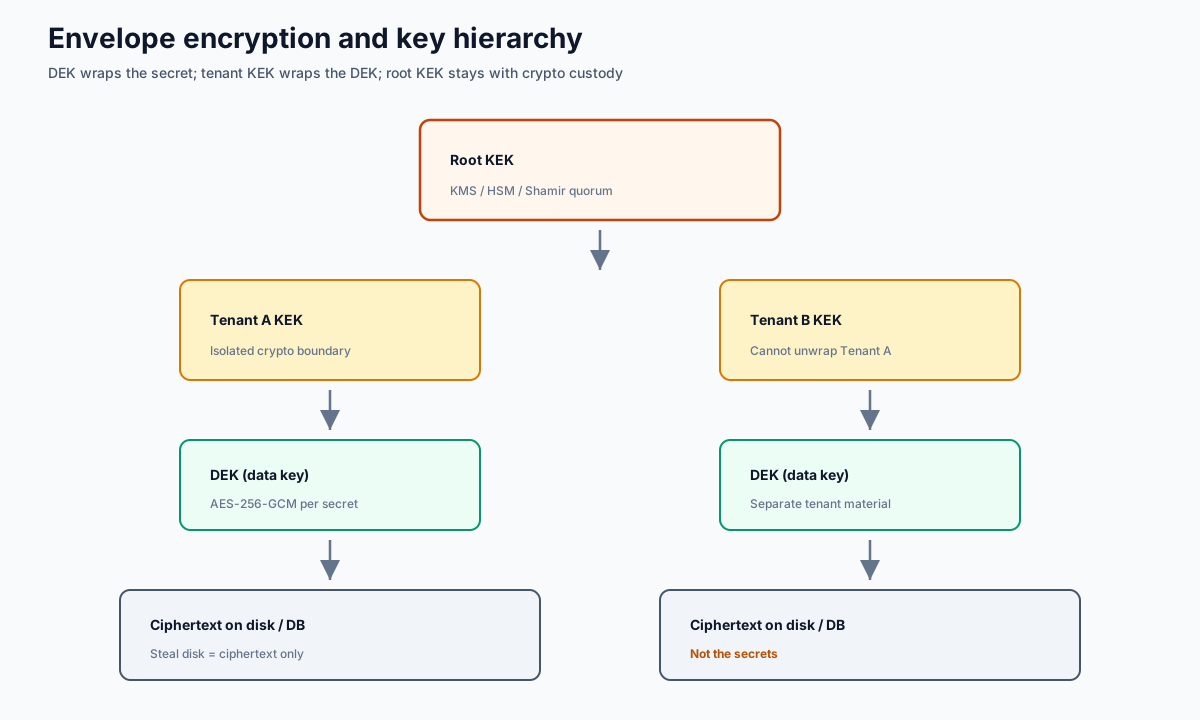
WSLVault envelope encryption key hierarchy

4. Engines still work per tenant

Isolation does not mean you lose Vault-compatible workflows. Per tenant you still get:

Engine Why agents care
KV v2Versioned config and API material sealed before disk — not plaintext beside the agent runtime
TransitEncrypt/decrypt/sign without exporting keys into the model or tool process
PKIShort-lived certs for mTLS between agent, MCP, and backends
LeasesDynamic credentials with renew/revoke — stop the agent, kill the access

5. Protect → rotate → manage (agent checklist)

  1. Protect — envelope encryption; root custody outside the data plane; no plaintext in backups or audit payloads.
  2. Rotate — rotate tenant KEKs and static roles on a period; keep old ciphertext readable via transit versioning where needed.
  3. Manage — identity-bound tokens (not trusted headers alone), fine-grained policies, MFA for operators, leases with real revoke for agent sessions.
  4. Prove — tamper-evident, hash-chained audit per tenant so you can show who did what without storing secrets in the trail.
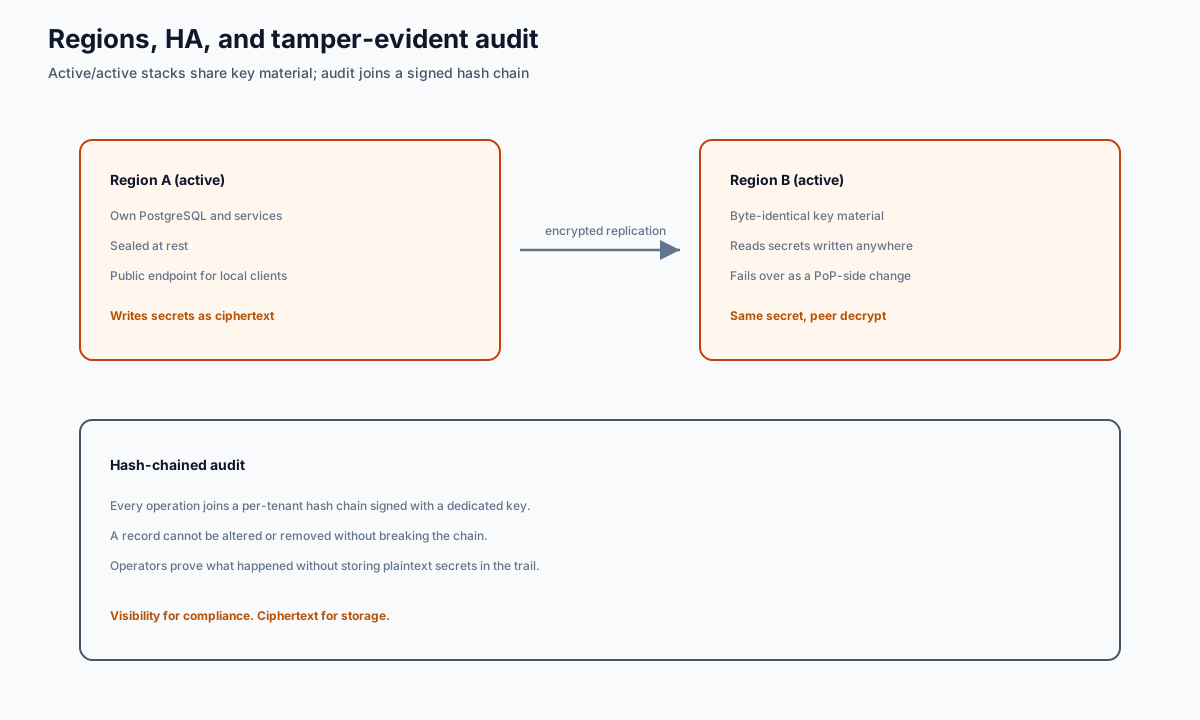
WSLVault multi-region and tamper-evident audit

6. Video chapters

Time Topic
0:00Why this matters (steal the server)
1:30What WSLVault is
3:00Envelope encryption and key hierarchy
5:30Multi-tenancy that actually isolates
8:00Console walkthrough (secrets, transit, PKI)
11:00Identity, policies, leases and MFA
14:00Regions, HA and audit
17:00Deploy on Kubernetes
19:00Where to go next

7. Where to go next

  • Site: https://www.wslvault.org/
  • GitHub: https://github.com/bwalia/wslvault
  • Getting started: GETTING-STARTED.md
  • Workstation product page: /en/wsl-vault
  • Intro brief: Steal the server. Not the secrets.
  • Related: Agentic AI security — MCP, OAuth, Vault leases

Published by Workstation.
分享这篇文章

更多 Technology 内容

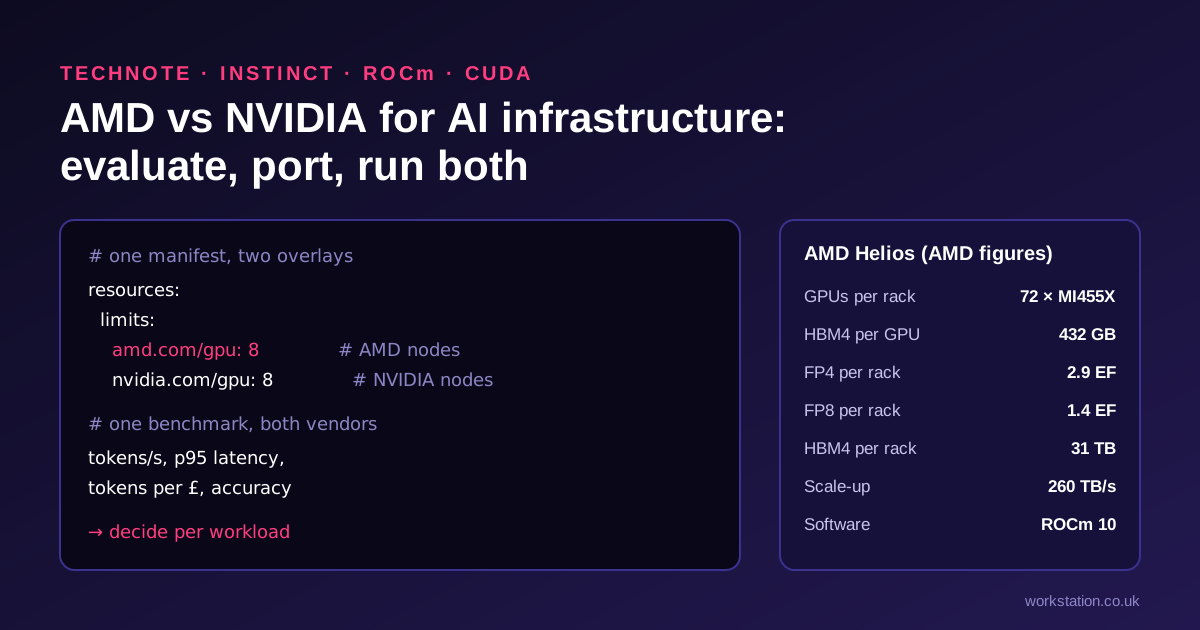
AMD Instinct vs NVIDIA for AI Infrastructure: Evaluate, Port and Run Both (2026)

AMD Instinct vs NVIDIA for AI Infrastructure: Evaluate, Port and Run Both (2026)

From Lisa Su's 2024 interview to Helios: the 2026 platforms layer by layer, Instinct product lines, memory arithmetic, the CUDA-to-ROCm software map, a porting workflow with commands, dual-vendor Kubernetes, fair benchmarking, a decision workflow and day-two operations

阅读更多
Private AI for Financial Data: Residency, Routing and Cost on AWS Bedrock, Microsoft Azure and Your Own GPUs

Private AI for Financial Data: Residency, Routing and Cost on AWS Bedrock, Microsoft Azure and Your Own GPUs

Billing models and idle cost, per-call cost at three volumes, Bedrock in-region vs EU profiles, Converse API with prompt caching and IAM region enforcement, Azure deployment types and Claude on Foundry, UK and EU providers, a residency-aware provider registry, cost-cutting workflow, a golden-set evaluation harness and GPU break-even

阅读更多
NVKE and NVKR Technote: Building a Managed GPU Kubernetes Service from Bare Metal, with Reproducible, Verifiable Builds

NVKE and NVKR Technote: Building a Managed GPU Kubernetes Service from Bare Metal, with Reproducible, Verifiable Builds

Architecture, components and pinned versions, the NVKR Definition-Run-Release-Verify lifecycle, the full nvkectl workflow from racked servers to a customer cluster, node attestation, day-two operations, every preview limitation with a mitigation, a comparison with other approaches and a staged evaluation plan

阅读更多